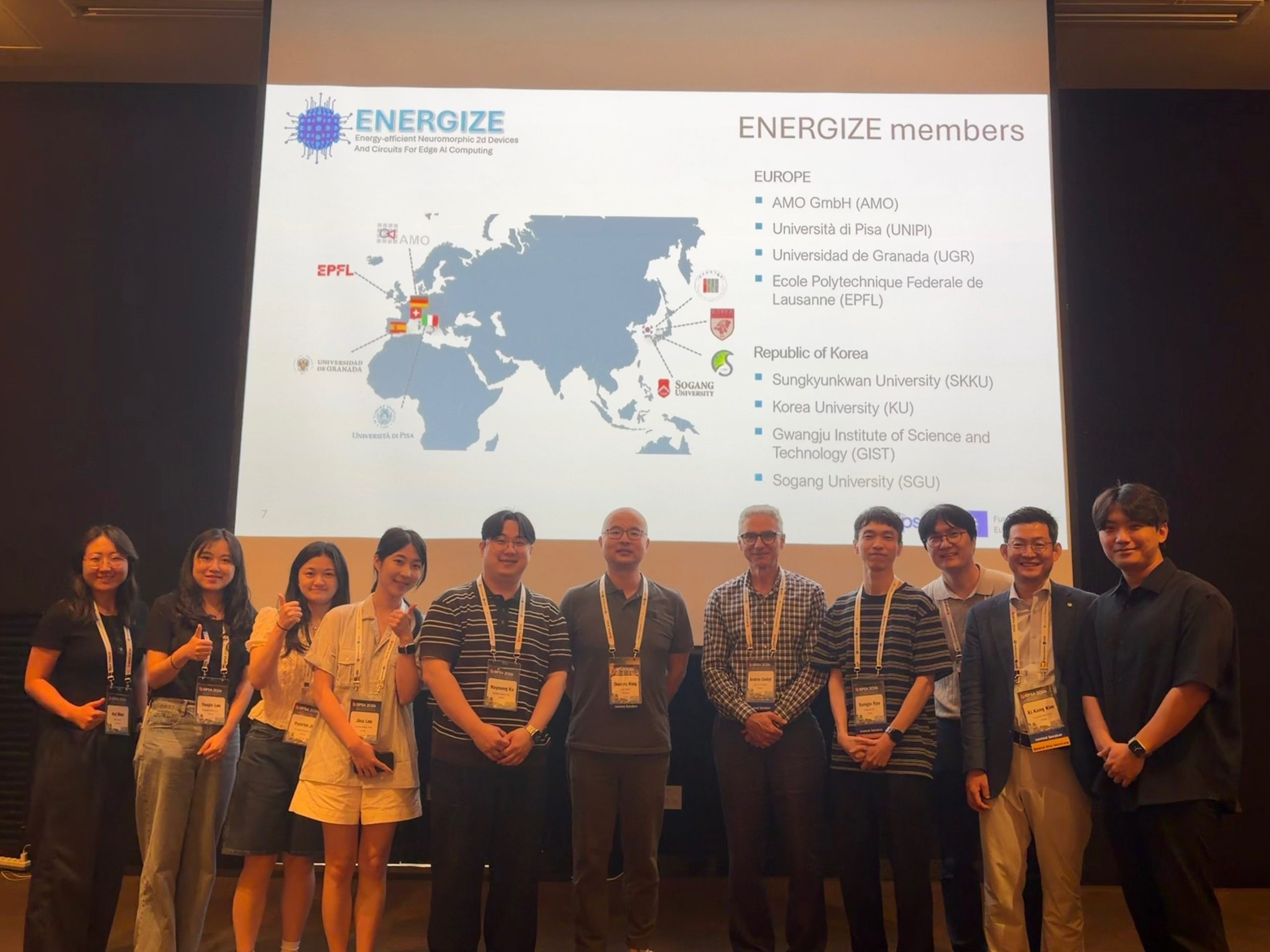
From 21 September to 4 October 2026, AMO GmbH welcomed Prof. Woo Jong Yu and two PhD students, Hong Woon Yun and Yong Ha Shin, from Sungkyunkwan University (SKKU), South Korea, for a two-week research visit within the framework of the EU–Korea collaborative project ENERGIZE.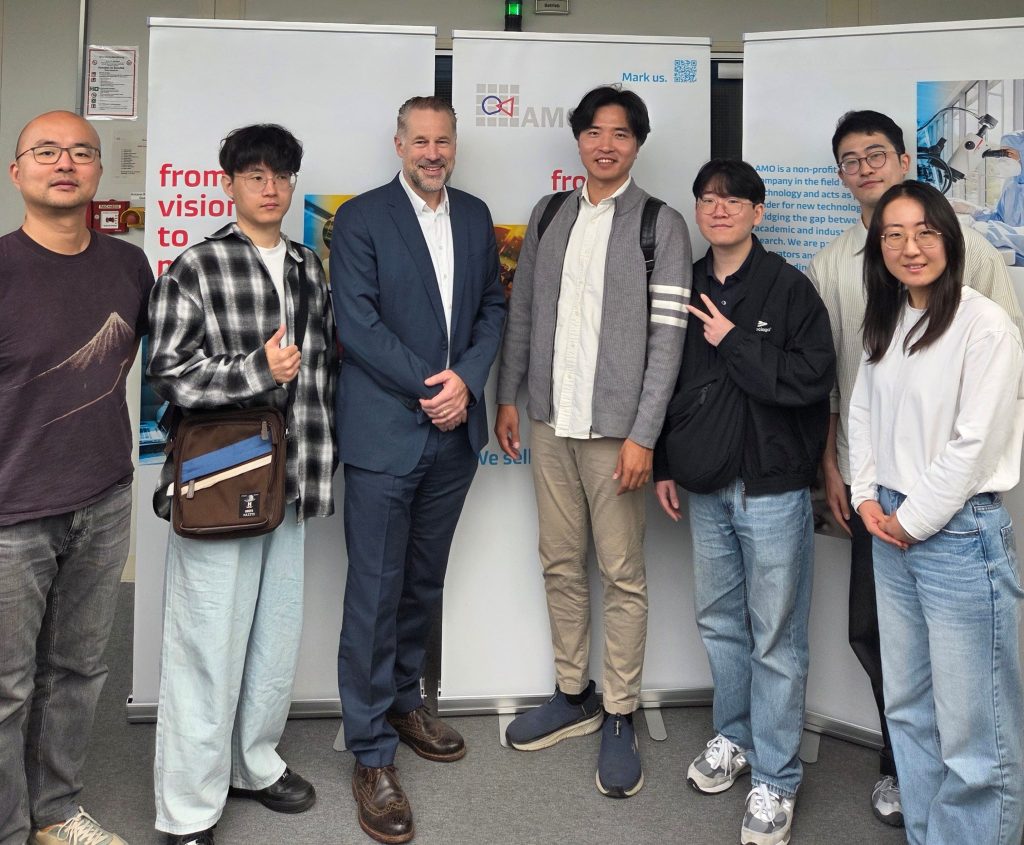
The visit provided an opportunity to strengthen scientific exchange between the project partners and advance joint research on energy-efficient neuromorphic devices based on two-dimensional (2D) materials – memristors, in particular.
Memristors are promising building blocks for next-generation computing architectures, as they can store information in their resistance states and potentially emulate some of the functions of biological synapses. By combining memory and information-processing capabilities, these devices could contribute to reducing the energy consumption associated with artificial intelligence applications.
During their stay at AMO GmbH in Aachen, the visiting researchers participated in cleanroom activities and scientific discussions on 2D material-based memristors. The joint research activities focused on exploring the potential of floating-gate device architectures for neuromorphic computing, drawing on the complementary expertise of SKKU and AMO in 2D materials, device physics, and nanofabrication.
A highlight of the visit was a seminar delivered by Prof. Woo Jong Yu on 1 October 2026, entitled “van der Waals integrated devices.” The seminar offered an opportunity for researchers at AMO and the wider Aachen scientific community to gain insights into research on devices based on van der Waals materials and heterostructures. Such structures, formed by combining atomically thin materials, offer new possibilities for engineering electronic devices with tailored properties. They are particularly relevant to the development of novel memory and computing technologies, including the neuromorphic hardware investigated within ENERGIZE.
 Beyond the scientific work, the visit contributed to one of ENERGIZE’s broader objectives: fostering long-term collaboration between European and Korean research institutions in the field of advanced semiconductor technologies. Direct exchanges between researchers, particularly involving early-career scientists, play an important role in sharing expertise, developing common research approaches, and strengthening collaboration across the project consortium.